PATHWAY 06 · REGGIO EMILIA
35.5951° N · 82.5515° W
A hundred languages
Project-based, emergent learning where children's own questions lead — and the environment is the third teacher.
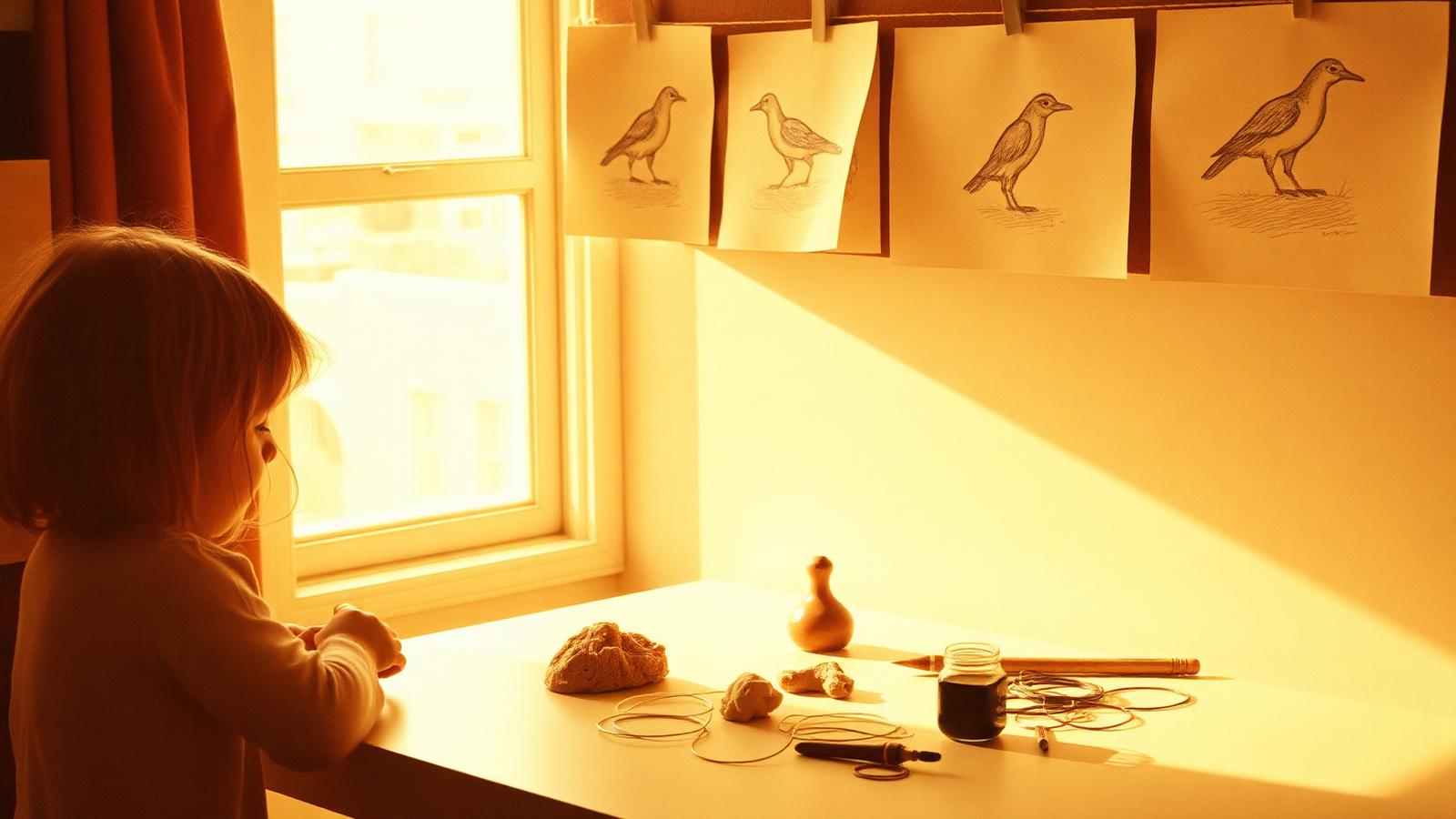
Reggio Emilia starts from a striking image of the child: capable, curious, a citizen with theories of their own. Learning grows from children's actual questions into long-running projects, expressed through what the approach calls a hundred languages — paint, clay, blocks, movement, conversation.
There is no Reggio box to buy, and that's not an oversight. It's a philosophy from a specific set of Italian preschools, which homeschoolers adapt rather than purchase. The parent's tools are materials, genuine questions, and a camera.
THE ROOTS
35.5951° N · 82.5515° W
The approach was born in the town of Reggio Emilia, Italy, after World War II, when parents rebuilding from the war founded preschools guided by educator Loris Malaguzzi. His conviction — that children express and deepen understanding through a hundred languages — shaped a municipal school system now studied worldwide.
HOW IT WORKS
35.5951° N · 82.5515° W
- 01
The image of the child. Children are capable co-constructors of knowledge, not empty vessels.
- 02
The hundred languages. Thinking deepens through many media: paint, clay, blocks, music, movement, words.
- 03
Emergent projects. Long investigations grow from children's own questions, not a preset scope-and-sequence.
- 04
The environment as third teacher. Beautiful, open-ended materials, displayed invitingly, do real teaching work.
- 05
Documentation. Adults photograph, transcribe, and display children's work to make learning visible — and to decide what comes next.
- 06
The adult as researcher. You study your child's thinking and provoke it with questions and materials.
A DAY ON THIS PATH
35.5951° N · 82.5515° W
The day opens with a provocation — materials arranged around a current interest. Say, bridges: blocks, wire, photographs, drawing tools. The child explores; the parent observes, asks real questions, and takes notes or photos. Projects stretch across weeks — a snail found in the garden becomes drawings, habitats, books, and a return to the first drawings to improve them. The parent's evening work is reviewing documentation and planning the next invitation.
WHO THRIVES HERE
35.5951° N · 82.5515° W
Early childhood through roughly age eight. Artistic, question-asking kids. Parents who genuinely enjoy open-ended process more than checklists.
WORTH WEIGHING
35.5951° N · 82.5515° W
There is no box to buy — the parent designs everything, which is creatively demanding. Progress is hard to measure against grade-level standards, systematic phonics and math need supplementing as children grow, and because "Reggio-inspired" is unregulated, the quality of online resources varies wildly.
THE MISCONCEPTION
“Reggio is an art curriculum.”
The art materials are everywhere, but they're a means, not the subject. The method is really about inquiry — children forming theories and testing them through many media, with the adult documenting the thinking behind the product.
TRAIL MARKERS
35.5951° N · 82.5515° W
Established organizations, curricula, and books to start with — chosen for depth, not commission. Perspective tags help every family self-select; we don't editorialize.
ORGANIZATIONS & COMMUNITY
The official North American network connected to Reggio Children; conferences, publications, study tours.
The official organization in Reggio Emilia, Italy, stewarding the approach at its source.
CURRICULA & PROGRAMS
Reggio has no official curriculum; these are honest adaptations.
- TinkerLabSECULAR
Process-art and creativity resources; the most practical Reggio-spirited site written for parents.
Courses and writing on Reggio-inspired, play-based practice; teacher-facing but widely used by homeschool parents.
Monthly hands-on, play-based kits for ages zero to five with a homeschool track; Reggio-adjacent rather than Reggio-branded — the realistic open-the-box option.
ON THE SHELF
Project-Based Homeschooling — Lori McWilliam Pickert
The single best parent-facing bridge from Reggio ideas to actual homeschooling; short and practical.
Bringing Reggio Emilia Home — Louise Boyd Cadwell
A teacher's year inside the Reggio schools; readable and story-driven, best as the go-deeper pick.
The Language of Art — Ann Pelo
Inquiry-based studio practices with concrete project walk-throughs; intermediate, but usable at a kitchen table.
WORTH A LISTEN
Active, parent-facing project ideas, weekly.
COMMON QUESTIONS
35.5951° N · 82.5515° W
Is there a Reggio Emilia curriculum I can buy?
+
No — and that is by design. Reggio is a philosophy from the municipal preschools of Reggio Emilia, Italy, not a franchise. Families adapt its practices; honest resources say “Reggio-inspired,” and anything sold as official Reggio curriculum should raise an eyebrow.
What ages is Reggio Emilia for?
+
Its home is early childhood — roughly ages two through eight. Beyond that, families usually carry its project-based, documentation-rich spirit into an eclectic or project-based middle-years homeschool.
What is a provocation?
+
A provocation is an invitation to explore: materials arranged thoughtfully around a child's current interest — blocks, wire, and bridge photographs, say — set out to provoke questions and theories rather than deliver a lesson.
How is Reggio different from Montessori?
+
Both prepare beautiful environments and respect the child. Montessori uses specific didactic materials with defined purposes and sequences; Reggio uses open-ended materials in emergent, collaborative projects that follow the child's questions wherever they lead.
WHERE PATHS CROSS
35.5951° N · 82.5515° W
Reggio's environment-first thinking sits close to Montessori; its child-led projects lean toward Unschooling. Families wanting its spirit with more scaffolding often land Eclectic.
Not sure this is your path? Find your bearings.
Take the 5-minute quiz